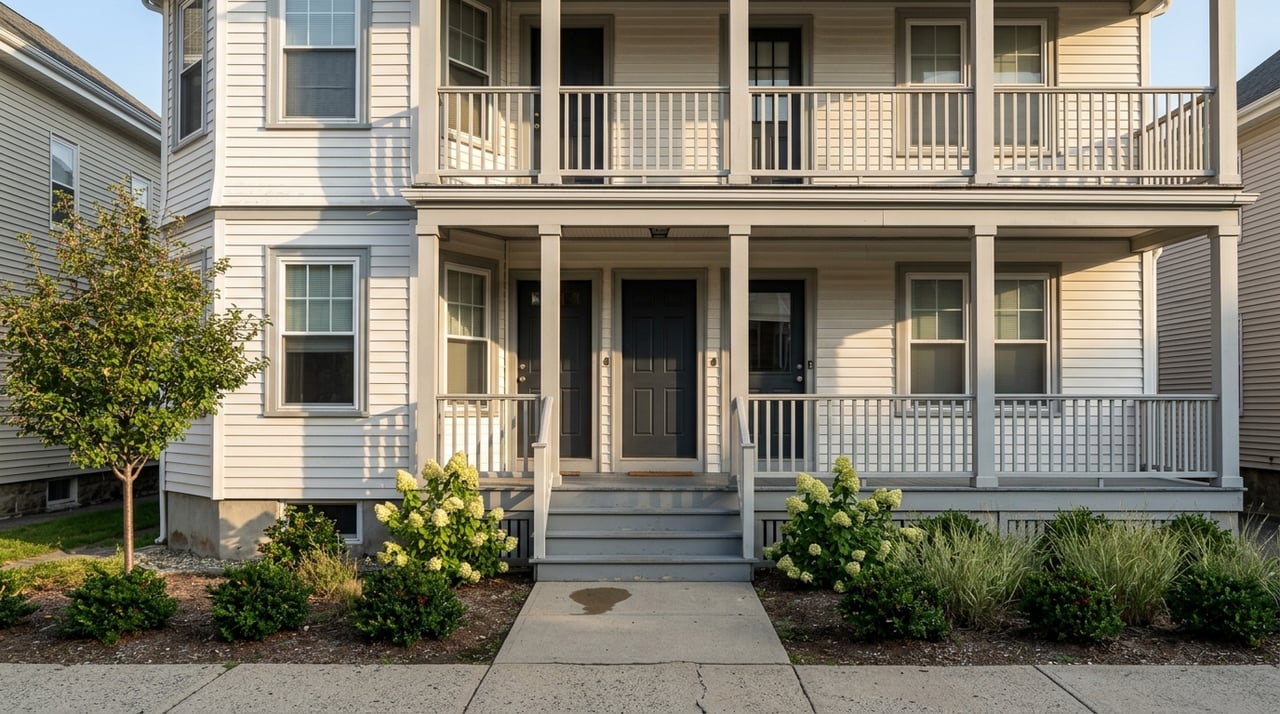
Thinking about buying a 2-family or 3-family in East Providence? You are not alone. For many buyers and small investors, this market offers a practical mix of rental demand, manageable scale, and owner-occupant potential without feeling as fast or as expensive as some nearby options. In this guide, you will learn how East Providence compares to nearby markets, what the numbers suggest, and which local rules matter most before you make a move. Let’s dive in.
Why East Providence draws investors
East Providence sits in an interesting middle ground. It is not the cheapest market in the area, but it is also not priced like a high-barrier urban core. That balance can appeal to buyers who want rental income potential along with modest appreciation and the option to live in one unit while renting the others.
According to Zillow’s East Providence rental data, the average rent in April 2026 was $2,067. Typical asking rents were $1,645 for a one-bedroom, $2,067 for a two-bedroom, and $2,600 for a three-bedroom. Zillow also reports a typical home value of $428,258, up 1.0% year over year, with homes going pending in about 18 days.
Those numbers point to a market with steady demand, but not one where you can assume every multifamily deal will cash flow well on paper. In East Providence, strong investing often comes down to buying the right property at the right basis and underwriting carefully.
East Providence vs nearby markets
If you are comparing East Providence with Providence, Pawtucket, or North Providence, broad averages suggest East Providence is competitive but not the obvious winner on cash flow alone. That matters because many buyers assume a smaller city automatically means lower prices and stronger returns.
Here is a quick look at current broad market comparisons from Zillow:
| Market | Average Rent | Typical Home Value | 1-Year Value Change |
|---|---|---|---|
| East Providence | $2,067 | $428,258 | +1.0% |
| Providence | $2,150 | $426,007 | +2.3% |
| Pawtucket | $1,794 | $387,713 | +0.9% |
| North Providence | $1,765 | $405,896 | +1.1% |
Based on the same Zillow market data, simple gross annual rent-to-value ratios come out to about 5.8% for East Providence, 6.1% for Providence, 5.6% for Pawtucket, and 5.2% for North Providence. These are not cap rates, but they are useful for rough comparison.
The practical takeaway is simple. Providence appears stronger for recent appreciation, while Pawtucket and North Providence may offer lower entry prices. East Providence lands in the middle, which can work well if you want a balanced play rather than chasing the cheapest purchase price possible.
What the numbers mean for multifamily buyers
For a small multifamily investor, East Providence looks more like a property-by-property market than a market where averages do all the work for you. If a building has a smart unit mix, solid condition, and realistic tax assumptions, it may pencil out well. If it needs major updates or carries higher operating costs, the margin can narrow quickly.
National and regional data also help set expectations. The National Association of Realtors commercial report reported a 6.1% national multifamily cap rate as of early 2025. In the Providence-Warwick metro, NAR reported $1,918 asking rent, $1,910 effective rent, 3.0% vacancy, and a 7.3% market cap rate in Q2 2024.
Using that broader context, a reasonable benchmark for stabilized small multifamily in East Providence is roughly the mid-6% to low-7% cap-rate range. That is an inference from national and metro-level data, not an official East Providence quote, but it gives you a useful starting point for underwriting.
Taxes can change the deal
One of the biggest mistakes small investors make is focusing only on price and rent while underestimating taxes. In East Providence, tax structure can meaningfully affect returns, especially if you are looking at mixed-use buildings or non-owner-occupied property.
According to the City of East Providence tax rate page, the current residential tax rate is $13.07 per $1,000 of assessed value. The effective owner-occupied rate is $11.24 after the 14% homestead exemption, while the commercial rate is $20.63.
That spread matters. If you plan to house hack in a 2-family or 3-family, owner occupancy may improve the math. If you are buying a mixed-use building or a fully non-owner-occupied asset, you will want to model taxes carefully from day one.
Owner-occupants may find a sweet spot
For many buyers, the strongest East Providence multifamily strategy is not pure investment. It is owner occupancy with rental income. Living in one unit while renting the others can help offset your monthly payment while giving you a foothold in a market that has shown stable values and consistent rental demand.
This approach can be especially attractive in a market like East Providence, where broad averages suggest balance more than bargain pricing. You may not be buying the lowest-cost multifamily in the region, but you could gain flexibility, local stability, and a property that serves both personal and financial goals.
That is one reason East Providence continues to stand out for practical buyers. It can suit people who want to build equity and income over time, rather than trying to force an ultra-high-cash-flow model in a market that does not naturally support it.
City planning supports housing growth
Long-term city direction also matters when you are evaluating a rental property. East Providence’s adopted planning goals suggest local support for more housing options, including mixed-use and affordable housing.
According to the city’s 2025 to 2035 comprehensive plan announcement, East Providence aims to promote affordable housing, create mixed-use housing, and grow housing across tax brackets. That does not guarantee appreciation or easier approvals for every project, but it does provide useful context for buyers considering infill, mixed-use, or small multifamily opportunities.
For investors, that kind of policy direction can be encouraging. It signals that housing growth is part of the city’s long-range vision rather than an afterthought.
Rhode Island landlord rules to know
Before you buy a rental property, it is worth understanding a few Rhode Island landlord-tenant basics. These rules can affect how you collect deposits, raise rents, manage registrations, and handle move-outs.
The Rhode Island landlord-tenant handbook says security deposits are limited to 1 month’s rent. A landlord also cannot charge an extra fee by calling it a pet deposit, though a separate furniture deposit may be allowed in a furnished unit and is also capped at 1 month’s rent.
After a tenant moves out, a landlord has 20 days to return the deposit or provide the balance with an itemized list of deductions. Wrongful withholding can lead to double damages plus attorney’s fees. That makes documentation and move-in or move-out records especially important.
The same handbook says written notice for a rent increase must be given at least 60 days in advance for tenants age 62 and under, and 120 days for tenants over 62. For month-to-month tenancies, termination requires written notice at least 30 days before the next rental due date.
Do not overlook the rental registry
Rhode Island now requires a statewide rental registry, and this is easy to miss if you are a first-time landlord. The handbook says landlords must register by October 1 each year and keep the information current.
Noncompliance can lead to monthly fines and may block a nonpayment eviction action. The handbook also says landlords must disclose owner or manager contact information to tenants at the beginning of the tenancy.
This is a good reminder that small multifamily investing is not just about finding tenants. Strong operations and compliance matter just as much as the purchase price.
Lead safety matters in older multifamily homes
Lead safety is another major issue for East Providence investors, especially because much of the small multifamily stock in Rhode Island is older. If you are looking at a 2-family or 3-family built before 1978, you should pay close attention here.
The Rhode Island landlord-tenant handbook says that as of January 1, 2024, owner-occupied 2- and 3-unit buildings built before 1978 are included in the state’s lead-safety requirements if they have not already been made lead safe or abated.
That means due diligence is essential. Before you buy, you will want to understand a property’s age, condition, existing documentation, and any likely compliance costs.
What a smart East Providence deal looks like
The best East Providence multifamily opportunities are likely the ones where the details beat the averages. In a market like this, strong deals often share a few traits:
- A practical unit mix that fits local rental demand
- Reasonable condition or clearly defined improvement needs
- Realistic rent assumptions based on current market data
- Accurate tax underwriting, especially for non-owner-occupied or mixed-use property
- A clear compliance plan for registry, deposits, notices, and lead safety
In other words, East Providence is not a market where you should buy on hope alone. It rewards careful analysis, local knowledge, and a plan that matches the property.
Final thoughts on investing here
If you are considering investing in multifamily property in East Providence, RI, the market offers a solid middle-ground opportunity. Rents are healthy, values have held up, and the city’s broader housing direction is supportive of growth. At the same time, East Providence is not an automatic cash-flow bargain compared with nearby Providence, so success often comes down to smart underwriting and finding the right building.
If you want help evaluating a 2-family, 3-family, or mixed-use opportunity in East Providence, Cathy Sousa can help you compare neighborhoods, review local market context, and move forward with clear, concierge-style guidance.
FAQs
What are current rents in East Providence for multifamily investors?
- According to Zillow’s April 2026 data, East Providence averages $2,067 in rent, with typical asking rents of $1,645 for 1BR, $2,067 for 2BR, and $2,600 for 3BR.
How does East Providence compare with Providence for multifamily investing?
- Broad averages suggest Providence has slightly higher average rent and stronger recent appreciation, while East Providence offers a middle-ground option that may appeal to buyers looking for balance rather than the highest possible rent-to-value ratio.
What cap rate should buyers expect for East Providence multifamily property?
- Based on national and Providence-metro data from NAR, a reasonable underwriting benchmark for stabilized small multifamily in East Providence is roughly the mid-6% to low-7% range, though actual performance depends on the specific property.
What is the East Providence property tax rate for investors?
- East Providence lists a residential tax rate of $13.07 per $1,000 of assessed value, an effective owner-occupied rate of $11.24 after the homestead exemption, and a commercial rate of $20.63.
What Rhode Island rental rules matter for East Providence landlords?
- Key rules include a 1-month rent cap on security deposits, a 20-day deadline to return deposits or provide deductions after move-out, required notice periods for rent increases, and annual compliance with the statewide rental registry.
What lead safety rules apply to East Providence 2-family and 3-family homes?
- In Rhode Island, owner-occupied 2- and 3-unit buildings built before 1978 are included in lead-safety requirements if they have not already been made lead safe or abated, so buyers should include this in their due diligence.