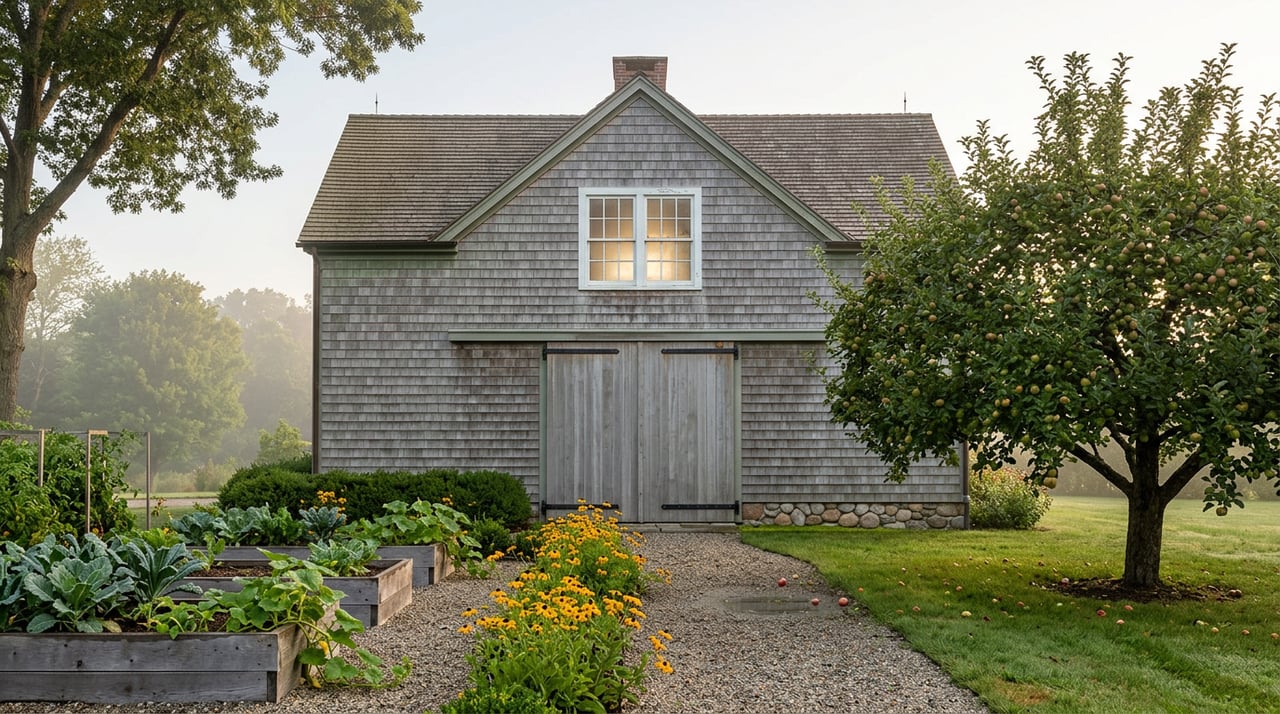
Every Saturday morning, cars turn off Metacom Avenue into the gravel lot at Mount Hope Farm, and the ritual plays out the same way it has for years. Someone grabs a coffee from one of the rotating vendors. A kid disappears toward the barn. Someone else circles back for a second loaf of sourdough before the good stuff sells out. It reads like the most ordinary errand on the West Side, the kind of thing you do without thinking about where you're standing.
That's the part worth stopping on. The 127 acres under your feet at that market are doing more historical and ecological work this year than almost any other piece of ground in the East Bay, and most of the people filling their tote bags have no idea.
Potumtuk, Not Just "The Farm"
The land Mount Hope Farm sits on has a name older than the farm, older than Bristol itself. The Pokanoket people called this promontory Potumtuk, and it served for generations as the seat of the Pokanoket Massasoits, including Ousamequin and his son Metacom, known to English colonists as King Philip. Metacom died on this ground in August 1676, an event that marked the end of King Philip's War, the fourteen-month conflict that reshaped colonial and Indigenous New England.
This month is the 350th anniversary of that death. Not a round-number milestone invented for marketing purposes but an actual date on the calendar, and Mount Hope Farm sat at the center of how Rhode Island chose to mark it. On August 13, the farm hosted a presentation from Don "Strong Turtle" Brown, Tribal Historian of the Pokanoket Tribe, as the culmination of a series of events held throughout Sowams, the ancestral homeland of the Pokanoket people, tracing the pivotal moments of the war and the diaspora that followed. The talk was organized jointly with the Bristol Historical & Preservation Society and the Sowams Heritage Area, part of the same commemorative push behind SowamsEarlyHistory.org and KPW350.org, a pair of research sites built by a retired Warren clinical psychologist whose interest in 17th-century local history turned into a six-hundred-page archive.
Mount Hope Farm's barn is also listed as an official Rhode Island 250 venue, tying the farm's programming into the state's broader commemoration of America's 250th anniversary this year. So the same barn where you pick up your eggs on Saturday has spent 2026 hosting some of the most substantive public history programming in the state.
The farm you visit for produce sits on the same ground where King Philip's War ended 350 years ago this month.
The Same Acreage, Doing Triple Duty
History isn't the only thing layered onto this property this year. In June, the farm marked a newer designation: Mount Hope Farm is now recognized as an arboretum, a status made official thanks to the farm's staff, volunteers, and arborist Matt "Twig" Largess, who travels the eastern seaboard searching out champion trees in old-growth forests. To celebrate, the Bristol Land Conservation Trust hosted a guided tree walk with Largess on June 1, focused on some of the significant, often native, specimens scattered across the property.
Earlier in the spring, the same acreage hosted a different kind of expert walk. On May 2, the Bristol Land Conservation Trust brought in Lauren Parmelee, Senior Director of Education at the Audubon Society of Rhode Island, for a 90-minute guided birding walk timed to peak spring migration. Whether you're a longtime birder or someone who just likes the idea of an excuse to be outside on a Saturday morning, that's the kind of programming that treats the farm as a naturalist site first and a market second.
Put those two threads together and a pattern emerges. In a single calendar year, one property on the West Side has functioned as a working farm stand, a certified arboretum, a birding destination, and the physical site of the state's most significant King Philip's War anniversary commemoration. Most residents interact with exactly one of those four identities and never notice the other three.
And Still, Every Saturday, It's Just the Market
None of this changes what the farmers market actually is on a week-to-week basis, which is a genuinely useful weekly stop. It runs every Saturday, year round, from 9:00 a.m. to 12:30 p.m. in summer and 10:00 a.m. to 12:30 p.m. in winter, when the market moves into the barn. In summer, live music runs alongside the stalls. EBT and SNAP participants can double their dollars through a Bonus Bucks match funded by Farm Fresh RI, a detail that matters if you're weighing where to do your weekly shopping and want your grocery budget to stretch further at a market with meat, fish, bread, coffee, and produce.
A few other things worth knowing if you treat the farm as a regular stop:
- The farm's Bristol Vintage Market returns this fall for its third annual run, with booths spanning farmhouse, coastal, mid-century modern, and European styles, set against the farm's pastoral, historic backdrop.
- Two more history and culture events close out August: a book talk on August 26 covering untold Black history in Jamestown, and a Rose Weaver jazz cabaret on August 27 celebrating local heritage.
- Indie Cycle LLC periodically sets up at the market for electronics recycling, taking computers, monitors, printers, and small appliances off residents' hands.
None of that requires you to care about the arboretum designation or the anniversary programming to get value out of a Saturday trip. But it's worth knowing that the same gravel lot you park in for bread and coffee is also where the town chose to gather for its most substantial 350th anniversary commemoration this year.
What the Overlap Actually Means
People who've lived on the West Side for a while already use that name the way locals use it, as its own distinct piece of Bristol, separate from the Hope Street corridor and its parade route, its restaurants, its harbor views. The West Side has its own rhythm, built around Metacom Avenue and anchored, whether residents fully register it or not, by a single working farm that keeps stacking new identities onto old ground.
That stacking is the actual story here. Most neighborhoods get one good local institution and lean on it. The West Side got a farm that quietly does the work of four, and the events that would headline a lifestyle guide anywhere else, a tree walk with a traveling arborist, a migration-season birding tour, a tribal historian's talk on a 350-year-old war, a certified arboretum designation, are treated here as one more thing that happens near the bread stand.
If you already live on the West Side, none of this changes your Saturday morning. But it might change how you think about the ground under it.
If you're weighing a move to this side of Bristol, or wondering what makes West Side living different from the rest of town, the Cathy Sousa Team knows this neighborhood block by block. Request a free home valuation or schedule a free consultation to talk through what the West Side actually offers, beyond the produce stand.